
Deed of Sale in Davao — What It Is, What It Must Contain, and Why the Drafting Matters

You have found the property. You have agreed on the price. You have shaken hands. Now comes the step that determines whether that agreement becomes a legal, enforceable transfer of ownership — or a source of conflict for years to come.
The Deed of Sale is not just paperwork. It is the legal instrument that converts a negotiated agreement into a binding transfer. In the Philippines, it is the foundational document for every significant property transaction — and in Davao’s fast-moving real estate and vehicle market, it is prepared and notarized thousands of times each year. When it is done correctly, it protects both buyer and seller clearly and completely. When it is done carelessly — with missing clauses, vague terms, or errors in the property description — it can expose either party to serious legal and financial risk.
If you are looking for a Deed of Sale in Davao — whether you need one drafted, reviewed, or notarized — this page gives you everything you need to know: what the document does, what it must contain, how it works for different types of property, what happens after it is signed, and how to find the right law office for Deed of Sale in Davao to do it properly.
What a Deed of Sale Is — And What It Actually Does
The Legal Effect of a Notarized Deed of Sale

When legal separation is granted, the property regime (whether conjugal partnership of gains or absolute community of property, depending on when you married) is dissolved and liquidated. Each spouse receives their share. The guilty spouse — the one found to have committed the ground for legal separation — forfeits their share of the net profits in favor of the children or the innocent spouse.
A Deed of Sale is a contract under which one party (the vendor or seller) transfers ownership of a specific property to another party (the vendee or buyer) in exchange for a sum of money (the consideration). It is the primary legal instrument of sale in the Philippines.
When a Deed of Sale is properly drafted and notarized by a commissioned notary public, it becomes a public instrument — a document that:
- Creates a legally recognized transfer of ownership from the moment of execution (for an Absolute Deed of Sale)
- Can be registered with the Registry of Deeds, making the transfer binding against third parties
- Is presumed authentic and regularly executed — it does not need additional proof of genuineness in court
- Triggers the obligation to pay Capital Gains Tax, Documentary Stamp Tax, and Transfer Tax within legally prescribed deadlines
Without notarization, a Deed of Sale is merely a private contract. It may bind the parties to each other, but it cannot be registered at the Registry of Deeds, and therefore cannot be used to transfer a Transfer Certificate of Title (TCT) into the buyer’s name.
Deed of Sale vs. Contract to Sell — The Distinction That Protects You
These two instruments are frequently confused — and the confusion can be costly.
| Feature | Deed of Sale (Absolute) | Contract to Sell |
|---|---|---|
| Ownership transfer | Immediately upon execution and delivery | Only upon full payment of the price |
| Title risk | Seller cannot later sell to another buyer | Seller retains title; buyer is at risk if seller defaults |
| Buyer's remedy if seller defaults | Rescission, damages, legal action on existing rights | Specific performance or cancellation per contract terms |
| Registration | Can be registered immediately | Not registrable as a transfer until conditions are fulfilled |
| Used for | Full-payment transactions | Installment sales, developer transactions |
The practical implication: A buyer who signs an Absolute Deed of Sale and pays the full price has immediate ownership rights. A buyer who signs a Contract to Sell (sometimes mislabeled as a “conditional deed of sale”) has a right to demand the property upon full payment — but does not yet own it. The legal exposures are different, and the clauses needed to protect each party are different. The document you sign should accurately reflect the transaction structure.
We also assist clients with Deed of Sale in the Poblacion District through our dedicated lawyer.
The Two Main Types of Deed of Sale in Davao
Absolute Deed of Sale
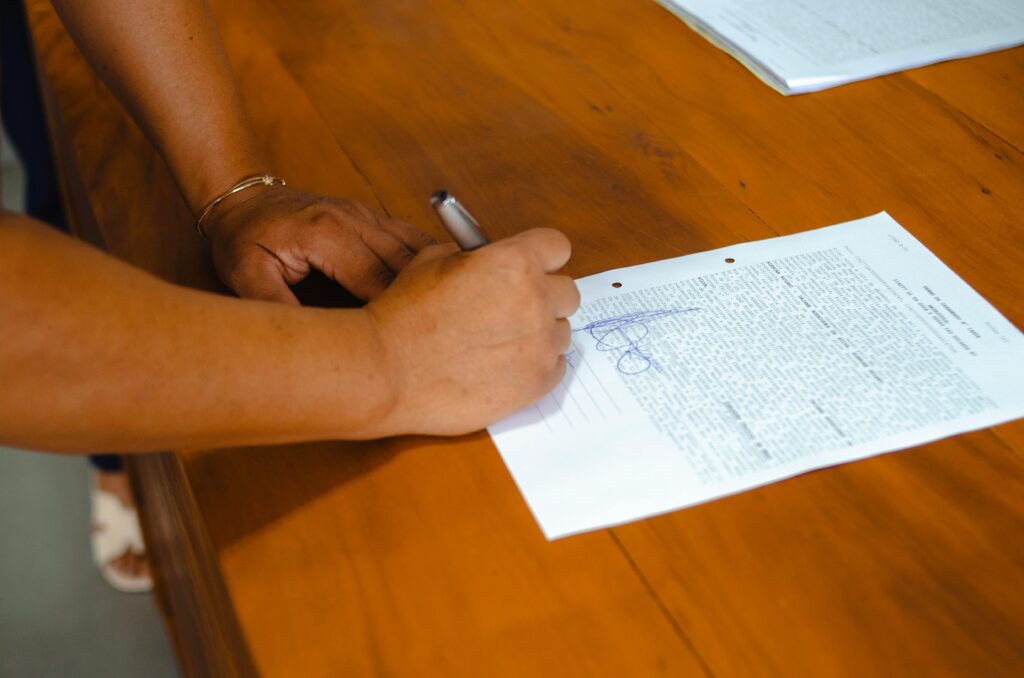
The Absolute Deed of Sale is used when the full purchase price is paid at the time of signing. Upon notarization and delivery of the document, ownership of the property passes to the buyer immediately and unconditionally.
This is the standard instrument for:
- Cash purchases of real property
- Property transactions where a third-party lender (like a bank) is financing and releasing the full amount at closing
- Vehicle sales where the full price is paid at signing
- Sales of personal property above significant value
An Absolute Deed of Sale is what the BIR requires for computing CGT and DST, and what the Registry of Deeds requires for processing a title transfer.
Conditional Deed of Sale / Contract to Sell

The Conditional Deed of Sale or Contract to Sell is used for installment transactions where ownership will not transfer until the full purchase price has been paid or other conditions have been met. The seller retains legal title until fulfillment.
This is the standard instrument for:
- Real estate developer installment sales (condominium units, subdivision lots)
- Private installment transactions between individuals
- Transactions where the buyer is still arranging financing
Key clauses in a well-drafted Contract to Sell:
- The total contract price and payment schedule
- The date by which full payment must be made
- The buyer’s right to a formal Absolute Deed of Sale upon full payment
- What happens to payments made if the buyer defaults (forfeiture vs. refund)
- The seller’s right to cancel and the required notice period
- The condition of the property at turnover
Warning: Contracts to Sell presented by developers often contain heavily seller-favorable terms — particularly on forfeitures and cancellations. Having a lawyer review the contract before signing is one of the most valuable and most underutilized protections available to Davao property buyers.
What a Valid Deed of Sale in Davao Must Contain
Essential Clauses Every Buyer and Seller Should Understand

A properly drafted Deed of Sale for real property in Davao must include:
- Full identification of the parties — Complete legal names, civil status, citizenship, and addresses of both seller and buyer. For married individuals, the spouse’s marital consent may be required.
- Complete description of the property — For real property, this means the title number (TCT or CCT number), the lot number and block number, the technical description as stated in the title (area in square meters, boundaries), the location, and the assessed value per the tax declaration.
- The consideration (purchase price) — The full price agreed upon, stated clearly in both numbers and words. This is the figure that also determines the BIR’s computation of CGT and DST — though the BIR will apply zonal value if higher.
- Confirmation of payment — An acknowledgment that the seller has received the full purchase price (for an Absolute Deed of Sale).
- Transfer of ownership — An explicit statement that the seller is transferring, conveying, and delivering ownership to the buyer.
- Warranty against eviction and hidden defects — The seller’s warranty that the property is free from all liens and encumbrances (except those disclosed), that the seller has the right to sell, and that the buyer will be protected against third-party claims.
- Marital consent — If the property is conjugal or community property, the non-selling spouse must sign a separate marital consent clause or appear as a co-signatory.
- Notarial acknowledgment — The clause at the end confirming that the parties appeared before the notary, presented valid IDs, and acknowledged the document as their free and voluntary act.
Clauses That Are Often Missing — And Why They Matter
Beyond the essentials, a well-drafted Deed of Sale protects both parties through specific additional provisions that many template deeds omit:
- Clause on who pays which taxes — CGT is technically the seller’s tax; DST, Transfer Tax, and registration fees are typically the buyer’s. But many transactions negotiate this differently. Whatever is agreed must be explicitly stated to prevent disputes later.
- Representation as to absence of tenants or occupants — The seller should warrant that the property has no current tenants or occupants who have not been properly notified of the sale and whose rights the buyer must now contend with.
- Representation as to CARP status — For properties in areas with agricultural history, the seller should warrant the CARP status of the land.
- Clause on real property tax arrears — Whether unpaid real property taxes are the seller’s responsibility to settle before transfer should be explicit.
- Dispute resolution clause — Where and how disputes arising from the deed will be resolved.
A deed missing these provisions is not necessarily invalid — but it leaves gaps that become contested when a problem arises. A well-drafted deed anticipates problems and resolves them before they occur.
Deed of Sale for Different Types of Property
Deed of Sale for Real Property (Land and Houses)
Real property deeds of sale are the most legally significant and most regulated. In addition to the elements above, they:
- Must be notarized to be registrable at the Registry of Deeds
- Trigger CGT (6% of the higher of selling price or BIR zonal value), DST (1.5%), Transfer Tax (0.75% in Davao City), and registration fees
- Require a Certificate Authorizing Registration (CAR) from the BIR before the Registry of Deeds will process the title transfer
- Must match the technical description on the existing title exactly — any discrepancy between the deed and the title causes rejection at the Registry
For inherited property: If the property has not been transferred from the deceased owner’s name, an Extrajudicial Settlement of Estate must be completed before or simultaneously with the sale. An EJS with Sale combines both instruments in one notarized document.
Deed of Sale for Motor Vehicles
A Deed of Sale for a used vehicle is required by the Land Transportation Office (LTO) for registration transfer. Key requirements:
- Complete details of the vehicle (make, model, year, engine number, chassis number, LTO plate number, MV file number)
- Full names and addresses of seller and buyer
- Declared selling price
- Notarization by a commissioned notary public
- Seller must sign over the OR/CR (Official Receipt and Certificate of Registration) to the buyer
Important LTO requirement: The buyer must present the notarized Deed of Sale when applying for transfer of registration at LTO Davao. A deed without proper notarization will not be accepted.
Deed of Sale for Personal Property
High-value personal property — equipment, machinery, jewelry, livestock — may also be the subject of a formal Deed of Sale. While notarization is not always legally required for personal property sales, a notarized deed:
- Creates a public instrument with stronger evidentiary value
- Establishes a clear record of the transaction date, price, and parties
- Reduces the risk of disputes about whether the sale took place or on what terms
What Happens After the Deed of Sale Is Signed and Notarized?
The BIR 30-Day Deadline You Cannot Miss
For real property transactions, the clock starts the moment the Deed of Sale is notarized. Under the National Internal Revenue Code:
Capital Gains Tax (CGT) must be filed and paid within 30 days from the date of notarization of the Deed of Sale.
Missing this deadline triggers:
- A 25% surcharge on the unpaid CGT
- 20% annual interest (or current BIR rate) from the deadline date
- A compromise penalty
These penalties are not waivable and must be paid before the BIR will issue the Certificate Authorizing Registration (CAR). On a typical Davao property transaction with a CGT of PHP 180,000, a missed 30-day deadline can add PHP 45,000 or more in penalties before the process can continue.
This is one of the clearest reasons to have a lawyer or law office handle the post-signing process — not just the signing itself.
The Full Post-Signing Process in Davao
After notarization, the following must be completed in sequence:
| Step | Office | What Happens | Timeline |
|---|---|---|---|
| 1. File CGT and DST returns | BIR RDO Davao (No. 113 or 114) | Pay taxes; receive CAR | Within 30 days of notarization |
| 2. Pay Transfer Tax | Davao City Treasurer's Office | Pay 0.75% transfer tax | Within 60 days of notarization |
| 3. Register the deed | Registry of Deeds for Davao City | Present CAR, pay registration fee, receive new TCT | After BIR and Treasurer |
| 4. Update tax declaration | Davao City Assessor's Office | New tax declaration in buyer's name | After Registry of Deeds |
Total estimated timeline: Eight to eighteen weeks from notarization to new TCT, depending on current processing volumes at the BIR and Registry of Deeds.
Why a Template Deed of Sale Is a Risk You Should Not Take
The Hidden Dangers of DIY or Downloaded Deeds
In the age of downloadable templates, many buyers and sellers attempt to prepare their own Deed of Sale using a form downloaded from the internet. Here is why this creates real legal risk:
Incorrect property description. The technical description in a Deed of Sale for real property must match the title exactly — lot number, block number, area, boundaries, and location. A single digit wrong in the lot number or area can cause the Registry of Deeds to reject the entire submission. Correction requires a new deed, re-notarization, and a restart of the BIR process — including penalties if the 30-day window has passed.
Missing required clauses. Templates rarely include the clause on marital consent, the warranty provisions the seller needs to be bound by, or the specific tax allocation agreement. These omissions become disputes later.
Wrong document type for the transaction. A template Absolute Deed of Sale used for what is actually an installment transaction misrepresents the legal nature of the deal and creates liability for both parties.
No legal review of what the seller is actually selling. A template deed takes the seller’s description of the property at face value. An attorney who drafts the deed verifies the title description, checks for encumbrances, and confirms the seller is actually authorized to sell — protecting the buyer from discovering problems after money has changed hands.
Notarization of a defective deed. A commissioned notary will notarize the document in front of them — they are not required to catch legal errors in the content. A notarized defective deed is still a defective deed.
The professional fee for having a qualified attorney at a reputable law office for deed of sale in Davao draft and review a deed is a fraction of the cost of fixing a defective one after the fact.
How to Find the Right Law Office for Deed of Sale in Davao
What to Look for in a Deed of Sale Attorney
- Active real estate law practice in Davao — Look for a law office that handles property transactions regularly, not one that does it occasionally as part of a general practice. Familiarity with the current BIR requirements, the Registry of Deeds’ submission standards, and the LTO requirements (for vehicle deeds) matters enormously.
- Full-service capability — The right law office does not just draft the deed and hand it back to you. They handle the notarization (with a commissioned notary public in Davao), the BIR filing, the Treasurer’s payment, and the Registry of Deeds submission — or at minimum coordinates and advises on each step.
- Title verification before drafting — A good attorney verifies the title before drafting the deed, not after. This protects the buyer from a deed that accurately describes a problematic property.
- Transparent, itemized fees — Professional fee for drafting, notarization fee, and government fees (CGT, DST, Transfer Tax, registration) should all be quoted separately and in writing.
- Commissioned notary public on premises — For efficiency, working with a law office where a commissioned notary is available means the deed can be notarized in the same engagement.
Questions to Ask Before You Hire
- Do you draft and notarize deeds in your office, or do I need to go elsewhere for notarization?
- Will you verify the title before drafting the deed?
- What is your fee for drafting, and is notarization included?
- Will you handle the BIR filing and the full post-notarization process, or only the deed preparation?
- What is the current BIR zonal value for this property, and how does it affect the CGT computation?
- What is the total cost estimate — professional fees plus all government fees?
Is a Deed of Sale legally binding even without notarization?
Complete every item before executing any property transaction:
- ✅ Title has been independently verified at the Registry of Deeds — not just reviewed from a photocopy the seller provided
- ✅ The Entry of Encumbrances on the title is clear of mortgages, adverse claims, and lis pendens
- ✅ Real property taxes are current (confirmed at Davao City Treasurer’s Office)
- ✅ The registered owner’s name matches the seller’s valid ID exactly
- ✅ For inherited property: Extrajudicial Settlement or other estate settlement has been completed or is being done simultaneously
- ✅ The deed correctly states the full legal name, civil status, and address of both parties
- ✅ The technical description in the deed matches the title’s technical description exactly
- ✅ The selling price and payment terms accurately reflect the actual agreement
- ✅ The tax obligation clause clearly states who pays CGT, DST, Transfer Tax, and registration fees
- ✅ Marital consent has been arranged for conjugal or community property
- ✅ Both parties will be present in person at the notarization — neither has pre-signed
- ✅ Both parties have valid government-issued IDs to present to the notary
- ✅ The BIR 30-day deadline for CGT is marked and planned for immediately after signing
Frequently Asked Questions
Is a Deed of Sale legally binding even without notarization?
Between the parties who signed it, a private (unnotarized) Deed of Sale is generally enforceable as a contract — both parties are bound by the agreement. However, without notarization, it cannot be registered at the Registry of Deeds, so the title cannot be transferred to the buyer’s name. The buyer would have personal rights against the seller but no registrable ownership. For real property transactions, notarization is not optional in any practical sense.
Can I use a downloaded template Deed of Sale in Davao?
You can — but it carries real risk. Template deeds frequently omit essential clauses, use incorrect property descriptions, mischaracterize the nature of the transaction, and lack the legal precision that prevents disputes. The BIR and Registry of Deeds have specific documentary requirements, and a defective deed that causes rejection restarts the clock on the 30-day CGT deadline — potentially triggering penalties. For a transaction of this significance, professional drafting is almost always worth the cost.
Both parties must be present for notarization — what if one is abroad?
If the seller is abroad, they must execute a valid Special Power of Attorney before the Philippine Consulate or Embassy in their country, authorizing a representative in Davao to sign the Deed of Sale on their behalf. The SPA holder then appears before the Davao notary and signs in the seller’s name. The same applies if the buyer is abroad. Plan this well in advance — consular appointments can take weeks.
What if the Deed of Sale states a selling price lower than the actual price?
This is sometimes done to reduce CGT — and it is both legally risky and potentially criminal. The BIR computes CGT based on the higher of the stated selling price or the BIR zonal value. If the stated price is below zonal value, the BIR applies the zonal value regardless. If the stated price is above zonal value but is significantly understated from the actual price agreed, this may constitute tax evasion — a criminal offense. Beyond legal risk, a deed that understates the actual price may expose the buyer to problems if the seller later claims they were deceived about the consideration.
What is the difference between a Deed of Sale and a Deed of Absolute Sale?
“Deed of Absolute Sale” and “Deed of Sale” are used interchangeably in common practice. Both refer to an unconditional transfer of ownership from seller to buyer upon execution. The word “absolute” simply emphasizes that there are no conditions on the transfer — as opposed to a “Conditional Deed of Sale” or “Contract to Sell,” where conditions (typically full payment) must first be met.
Does the spouse need to sign the Deed of Sale?
It depends on the property regime and ownership. For property that is part of the Absolute Community of Property (marriages after August 3, 1988, without a prenuptial agreement) or the Conjugal Partnership of Gains, the non-selling spouse must give consent to the sale. This is typically done by having the spouse sign a marital consent provision in the deed itself, or by both spouses signing as co-sellers. A sale of conjugal or community property without the other spouse’s consent is voidable.
What happens if the seller dies after the Deed of Sale is signed but before the title is transferred?
The legal effect of the deed is not undone by the seller’s death after execution. Ownership passed to the buyer upon the Absolute Deed of Sale’s execution and delivery. The heirs of the deceased seller are bound by the deed and cannot claim the property as part of the estate. However, completing the BIR and Registry processes after a seller’s death does become more administratively complex — another reason to move quickly on the post-signing government filings.
Can a Deed of Sale be cancelled after it is signed and notarized?
An Absolute Deed of Sale that has been fully executed, notarized, and delivered is extremely difficult to cancel unilaterally — it is a public instrument that has transferred ownership. Cancellation would require either the mutual consent of both parties (documented in a rescission agreement) or a court order based on legal grounds (fraud, mistake, incapacity, or other vitiating consent factors). This is why reviewing the deed carefully before signing is critical — once signed and notarized, it is not easily undone.
Can the Deed of Sale be used for both land and the house built on it?
Yes. A single Deed of Sale can cover the land and all improvements built on it (the house, buildings, or other structures). The deed should clearly describe both the land (with the technical description from the title) and the improvements (type, location, approximate value). If the improvements are significant, a separate appraisal or reference to the tax declaration’s assessed value for improvements helps establish the complete picture of what is being sold.
Do I need to pay for the deed preparation or is it the seller's responsibility?
There is no fixed rule in Philippine law about who pays for deed preparation. In practice, most Davao real estate transactions allocate the cost of deed preparation to the buyer — since the buyer typically engages the attorney and the law office that processes the transaction. This is, however, negotiable and should be agreed upon before engaging any professional services. Whatever is agreed should be stated in the deed itself, along with the allocation of taxes and registration fees.
Need a Deed of Sale Prepared or Notarized in Davao? Talk to Us Today
A Deed of Sale prepared correctly is invisible — it just works. The title transfers, the taxes are filed on time, the Registry of Deeds accepts the submission, and both parties walk away with exactly what they agreed to. A deed prepared carelessly is the opposite: delays, rejections, penalties, and in the worst cases, legal disputes over what was actually sold and on what terms.
Our law office in Davao prepares and notarizes Deeds of Sale for real property, vehicles, and personal property with the precision that every significant transaction deserves. We verify the title before drafting, use our commission as a deed of sale notary in Davao to execute the document properly, and handle the BIR filing and post-signing government process on your behalf.
Here is what working with us looks like:
- Complete draft review of the deed before any signing happens
- Title verification as part of the engagement (for real property transactions)
- BIR zonal value check and CGT computation before you commit to the transaction
- Professional notarization by our commissioned notary in Davao
- Post-signing BIR, Treasurer’s, Registry, and Assessor’s coordination
- Transparent, itemized fee breakdown — no surprises
One engagement, handled completely. So you can focus on the transaction, not the paperwork.
Schedule a consultation for Deed of Sale preparation in Davao today!
Get your Deed of Sale done right — the first time.
We also serve these areas:
Compassionate Legal Guidance You Can Trust
Navigating family or property matters can feel overwhelming — but you don’t have to face them alone. Our office provides clear, personalized, and compassionate legal support for every client.