
Notary Public in Davao — Fast, Reliable Notarization for All Your Legal Documents

You have the document. You just need it notarized. And you need it done right, because whether it is a Special Power of Attorney your sibling needs before leaving for abroad, a Deed of Sale for a property transaction, or an affidavit required by your employer or a government agency, a defective notarization can invalidate the entire document.
If you are looking for a Notary Public in Davao, one who is properly commissioned, offers reliable notarization services, and can get you in and out efficiently without the runaround, you are in the right place. Whether you are searching for a notary near you in Davao City or need professional help with a specific document, this page tells you exactly what to expect.
This page covers everything: what notarization means legally, which documents we handle, what you need to bring, how to prepare each type, common mistakes that cause rejection, and how to verify that the notary you are using is legitimately commissioned. Because in Davao, not everyone offering notarization services actually holds a current commission, and the difference matters enormously for the legal standing of your document.
What a Notary Public Actually Does — And Why It Matters
The Legal Effect of Notarization in the Philippines
Many people think of notarization as a formality — a stamp and a signature that makes a document “official.” The legal reality is more significant than that.
Under the 2004 Rules on Notarial Practice (A.M. No. 02-8-13-SC), a notary public in the Philippines performs three critical functions:
- Verifies the identity of the signatory — The notary confirms that the person signing the document is who they claim to be, by examining a valid government-issued ID at the time of signing.
- Confirms that the signatory signed voluntarily and is competent — The notary attests that the person was present, understood what they were signing, and was not under duress or incapacity.
- Converts the document into a public instrument — A notarized document becomes a public document, which in Philippine law carries a presumption of authenticity and due execution. It can be used in court and before government agencies without further proof of its genuineness.
The practical consequence: a properly notarized document has significantly greater legal weight than a privately signed one. It is presumed authentic. Courts and government offices accept it as reliable evidence. For many transactions — property sales, powers of attorney, affidavits filed with government agencies — notarization is not optional. Without it, the document is simply not valid for its intended purpose.
How a Notarial Commission Works in Davao
A notary public in the Philippines is a lawyer commissioned by the Executive Judge of the Regional Trial Court in the city or province where they practice. The commission is issued for a specific term and for a specific territorial jurisdiction.
This means:
- Only lawyers can be commissioned notaries in the Philippines. A non-lawyer offering notarization services is acting illegally and any document they “notarize” is invalid.
- A notarial commission is territorial. A notary commissioned in Davao City can only notarize documents within Davao City (or the covered jurisdiction stated in their commission). A notary commissioned elsewhere cannot validly notarize documents in Davao.
- The commission has a term — typically two years, renewable. An expired commission means any subsequent notarizations are void.
This is why verifying a notary’s commission — not just assuming that anyone with a notarial seal is legitimate — matters. Later in this page, we explain how to verify.
Documents We Notarize in Davao
Our notarial practice in Davao covers the full range of documents that individuals, families, and businesses need notarized in day-to-day legal and commercial life. Here are the most common.
Affidavits
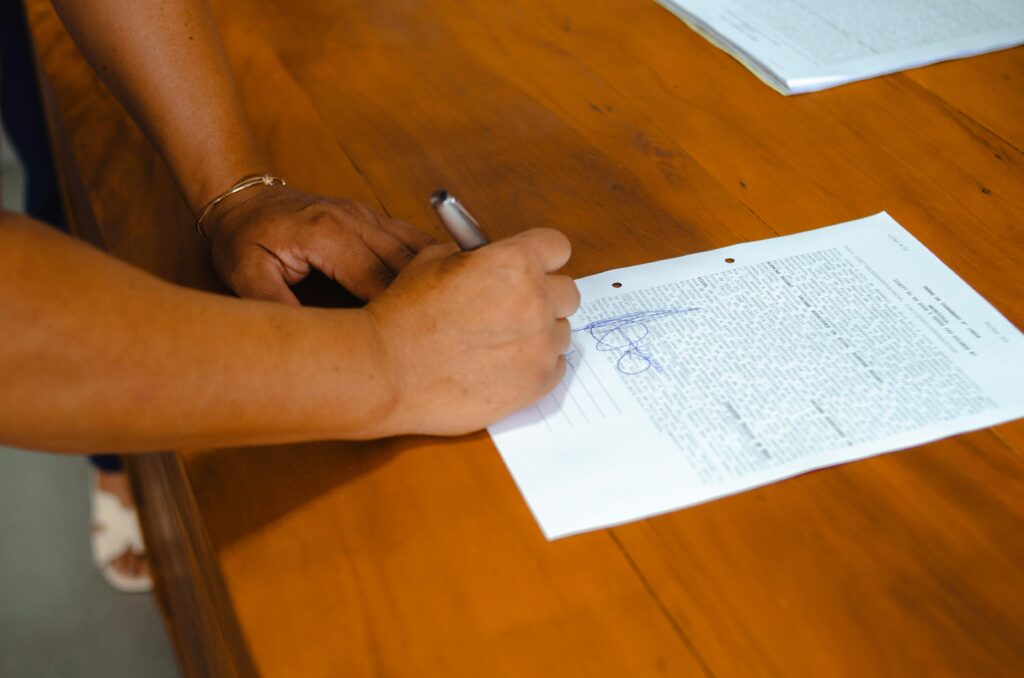
An affidavit is a written sworn statement of facts made under oath before a notary public. It is one of the most frequently notarized documents in the Philippines, required in an enormous range of situations.
Common types of affidavits we notarize:
- Affidavit of Loss — For lost IDs, documents, passbooks, or personal property. Required by banks, government agencies, and many institutions before issuing replacements.
- Affidavit of Support — Used by a sponsor to confirm financial support for a person traveling abroad or applying for a visa.
- Affidavit of Residency / Domicile — Confirms a person’s place of residence for enrollment, employment, or government transactions.
- Affidavit of Guardianship — Used (with limitations) in school enrollment contexts when parents are abroad.
- Affidavit of Desistance — Filed in connection with criminal complaints to indicate the complainant no longer wishes to pursue the case.
- Joint Affidavit of Two Disinterested Persons — Required for various government transactions including late registration of birth, civil registry corrections, and others.
- Affidavit of Self-Adjudication — For sole heirs settling a deceased family member’s estate.
- Affidavit of Undertaking — Used in many government agency transactions to confirm a commitment.
- Affidavit of Delayed Registration — For births, deaths, or marriages not registered within the required period.
- Affidavit of Cohabitation — For couples who have lived together for at least five years and are using this as a substitute for a marriage license under the Family Code.
- Affidavit of Discrepancy — To reconcile inconsistencies between two documents, such as a name spelled differently across a birth certificate, SSS record, and LTO license.
- Counter-Affidavit — Filed in response to a complaint-affidavit in a criminal or administrative proceeding.
What to bring for affidavit notarization in Davao: Valid government-issued ID (original), the fully accomplished affidavit (original, not photocopied), and the affiant must appear personally before the notary. If you are not sure where to notarize your affidavit in Davao, our office handles all affidavit types, walk-ins welcome during office hours.
Learn more about Affidavit of Loss for common documents in Davao
Special Power of Attorney (SPA)

A Special Power of Attorney is a document authorizing another person (the attorney-in-fact) to perform specific acts on your behalf. It is one of the most important notarial instruments in Davao, given the city’s large OFW population and the frequency with which people need to authorize others to transact on their behalf.
Common purposes for an SPA in Davao:
- SPA for property sale or transfer — Authorizing a family member to sell, transfer, or mortgage real property or land on your behalf, including signing the Deed of Sale and processing the title transfer
- SPA for bank transactions — Authorizing someone to manage a bank account, make withdrawals, encash checks, or receive funds in your name
- SPA for OFW use — Authorizing a trusted relative to handle all transactions while you are working abroad, from school enrollment to government agency transactions
- SPA for processing documents — Authorizing a representative to appear before the BIR, Registry of Deeds, or other government offices on your behalf
- SPA for business or vehicle transactions — Authorizing someone to manage a business arrangement or process a vehicle registration transfer
What the SPA must contain: The full legal name and address of both the principal (the person granting authority) and the attorney-in-fact, a specific and clear description of the acts authorized, and a statement of the duration of the authority if it is time-limited.
Whether you need SPA drafting or simply need an existing SPA notarized in Davao, our office handles both, with same-day service available for straightforward instruments.
Critical tip for OFW parents: If you are leaving Davao to work abroad and want to authorize a family member to act on your behalf, for property, school, banking, or other matters, prepare and notarize the SPA before you leave. An SPA executed in the Philippines and notarized by a Davao notary is simpler, faster, and less expensive than one executed abroad before a Philippine Consulate, which requires consular fees, an appointment, and significantly more time.
See our guide on Special Power of Attorney for OFW families in Davao →
Deed of Sale

The Deed of Sale is the primary legal instrument transferring ownership of real property (or personal property of significant value) from seller to buyer. Whether you need a property Deed of Sale drafted from scratch or an existing deed notarized in Davao, both services are available at our office. For real property transactions, notarization is not merely advisable, it is a legal requirement for the deed to be valid as a public instrument and registrable at the Registry of Deeds.
Types of deeds of sale we notarize:
- Absolute Deed of Sale (real property) — Full payment, immediate transfer of ownership
- Conditional Deed of Sale / Contract to Sell — Installment basis; transfer conditional on full payment
- Deed of Sale of a Motor Vehicle — For used vehicle transactions
- Deed of Sale of Personal Property — For high-value personal property transactions
What to bring for Deed of Sale notarization: Valid government-issued IDs of both buyer and seller (originals), the fully accomplished and signed deed (prepared by your attorney or the parties), and both parties must appear personally before the notary at the time of notarization.
Important: Both the seller and the buyer must be physically present when the deed is notarized. A deed signed by only one party in the notary’s presence, with the other party’s signature pre-affixed, does not comply with the 2004 Rules on Notarial Practice and may be challenged as defective.
Don’t have a legal document drafted yet? Let our real estate attorneys draft your Deed of Sale in Davao first to avoid costly legal errors.
Contracts and Agreements

Any written contract, lease or rental agreement, employment contract, service agreement, construction contract, partnership agreement, joint venture, or compromise agreement, can be notarized to elevate it to the status of a public instrument and strengthen its evidentiary value.
While not all contracts legally require notarization to be binding, notarized contracts are:
Presumed authentic and regularly executed
More difficult to challenge or deny
Admissible in court without additional proof of genuineness
Required by some government agencies and financial institutions as a condition of acceptance
Lease agreements in particular: Davao’s active rental market, residential and commercial, means lease and rental agreements are among our most frequently notarized contracts. A notarized lease agreement provides both landlord and tenant with a legally recognized document that is much easier to enforce in court if the relationship breaks down.
Need a contract drafted before notarization? See our Contract Drafting services in Davao → If you have received a contract from another party and want it reviewed before signing, our Contract Review service → can help you understand exactly what you are agreeing to.
Deed of Donation
A Deed of Donation is the legal instrument by which a person voluntarily transfers property to another without receiving payment in return. If you are donating real property in Davao, whether to a family member, a relative, or an institution, both the Deed of Donation preparation and its notarization are required for the transfer to be legally valid. For real property, an unnotarized deed of donation is void under the Civil Code.
What you need to know:
- The donor must be of legal age and have capacity to donate
- The donation of real property must be in a public instrument (notarized deed)
- The acceptance by the donee must also appear in a public instrument — either in the same deed or in a separate notarized document
- Donations may be subject to Donor’s Tax depending on the relationship between donor and donee and the value donated
Extrajudicial Settlement of Estate
An Extrajudicial Settlement of Estate, the out-of-court instrument used by heirs to divide and transfer inherited property, must be notarized by a commissioned notary public. This is one of the most important steps in any inheritance settlement in Davao: without a properly notarized EJS, the inherited property transfer cannot be processed at the BIR or the Registry of Deeds.
The EJS is then required to be published in a newspaper of general circulation for three consecutive weeks before submission. Because the EJS involves multiple signatories (all the heirs), careful coordination of the signing ceremony is required. All heirs must sign before the same notary, or through duly authorized representatives with consularized SPAs for those abroad.
Need help with the full estate settlement process, not just the notarization? Learn about our Extrajudicial Settlement of Estate services in Davao →
Other Commonly Notarized Documents
Beyond the major categories above, we regularly notarize:
- Authorization letters requiring notarization — for bank transactions, release of documents, or government agency requirements
- Acknowledgment receipts — for loans or significant cash transactions
- Certifications — employment, residency, financial capacity
- Undertakings and waivers — for insurance, employment, and contractual purposes
- Deeds of Real Estate Mortgage (REM) — when property is pledged as security for a loan
- Compromise Agreements — court-approved or out-of-court settlements
- Articles of Partnership or Incorporation — for business formations requiring notarial authentication
What to Bring for Notarization in Davao
The Standard Requirements
For every notarization, without exception:
- Valid government-issued ID with photo and signature — Accepted IDs include: passport, PhilSys National ID, driver’s license, UMID/SSS/GSIS ID, PRC ID, Voter’s ID, postal ID, or any other ID considered valid under the 2004 Rules on Notarial Practice. Photocopies are not sufficient — you must present the original.
- The original document to be notarized — Fully accomplished, correctly filled out, and ready to sign in front of the notary. Do not sign the document before arriving — the signatory must sign in the notary’s presence.
- The signatory must appear in person — No exceptions. A notary cannot notarize a document for someone who is not physically present. This is one of the most fundamental rules of Philippine notarial practice.
Document-Specific Requirements
| Document Type | Special Requirements |
|---|---|
| Deed of Sale (real property) | All parties (buyer + seller) must be present with valid IDs |
| Special Power of Attorney | Principal must be present; attach description of specific authority |
| Extrajudicial Settlement | All heirs must be present or represented by SPA holders |
| Affidavit of Loss | Affiant must be present; bring copy of lost document if available |
| Deed of Donation (real property) | Donor and donee must appear; bring title details |
| Lease Agreement | Both landlord and tenant should be present for joint acknowledgment |
Common Reasons a Notarization Is Rejected — And How to Avoid Them
Government agencies and the Registry of Deeds do return notarized documents for deficiencies. The most common reasons — and how to prevent them:
- Signatory did not appear in person. The 2004 Rules require personal appearance. A document with a pre-signed signature that the notary simply stamped is technically invalid. Always sign in front of the notary.
- Invalid or expired ID presented. Community Tax Certificates (cedula) alone are no longer valid for notarization under the 2004 Rules. Present a qualifying government-issued photo ID.
- Incomplete document. Blank spaces in a document being notarized — particularly for names, dates, or amounts — create problems. Complete the document fully before the signing ceremony.
- Wrong type of notarial act. Some documents require acknowledgment (the signatory acknowledges the instrument as their free and voluntary act); others require a jurat (the signatory swears under oath to the truthfulness of the contents). Affidavits require a jurat; deeds typically require acknowledgment. Using the wrong form can make the document invalid for its intended purpose. A good notary will know which applies.
- Notary’s commission is expired or from a different jurisdiction. The notarization of a document by someone whose commission has expired, or who is notarizing outside their territorial jurisdiction, is void.
- Document not in the official language. Documents must generally be in Filipino or English. Documents in other languages require certified translation before notarization.
Notarization vs. Authentication vs. Apostille — Clearing Up the Confusion
Three terms that are frequently confused, particularly by OFWs and families dealing with documents for overseas use:
Notarization — The act of a Philippine notary public certifying a document for use in the Philippines. This is what you do for domestic transactions: property sales, SPAs used locally, affidavits for Philippine agencies.
Authentication (Red Ribbon / DFA Authentication) — When a Philippine document will be used abroad, it must typically be authenticated by the Department of Foreign Affairs (DFA). This involves verifying the signature of the notary or government official on the document. Traditionally known as “red ribbon” authentication, this process has been largely replaced by Apostille for countries that are party to the Hague Convention.
Apostille — The Philippines acceded to the Hague Apostille Convention, and as of May 14, 2019, Philippine documents destined for Apostille-member countries no longer need DFA authentication in the traditional sense — they need an Apostille Certificate issued by the DFA. The Apostille is the internationally recognized form of authentication for documents going abroad.
The practical flowchart for OFW documents:
- Document is notarized in the Philippines (by a commissioned Davao notary)
- DFA issues an Apostille for use in Apostille-member countries — or DFA authenticates for non-member countries
- Document is used abroad (or submitted to a Philippine Consulate for additional steps if required by that country)
If you need a document prepared in Davao for use abroad, your notary should be able to advise you on the correct sequence for the specific country involved.
OFW and Overseas Documents — Consular Notarization vs. Davao Notarization
For OFWs who are already abroad and need a document notarized, the option is consular notarization before the nearest Philippine Consulate or Embassy. Consular officers are authorized to perform notarial acts for Filipinos abroad.
Consular notarization vs. Davao notarization:
| Factor | Davao Notarization | Consular Notarization |
|---|---|---|
| Where done | In Davao, before your departure | In the country where the OFW is based |
| Processing time | Same day | Requires consular appointment (days to weeks) |
| Cost | Lower | Consular fees + potential translation costs |
| Convenience | Significantly easier | Dependent on consular availability |
| Document validity | Valid for Philippine use | Valid for use that requires authentication or Apostille afterward |
The clear recommendation: If you know you will need an SPA, a Deed of Sale, or any notarized document while you are abroad — have it prepared and notarized in Davao before you leave. The time, cost, and logistical difference is significant.
How Much Does Notarization Cost in Davao?
Notarization fees in the Philippines are guided by the IBP Chapter schedules and individual notary fee schedules, but are not fixed by law for most document types. Here is a realistic range:
| Document Type | Typical Fee Range | Notes |
|---|---|---|
| Simple affidavit (1 page) | PHP 200 – PHP 500 | Higher for complex or lengthy affidavits |
| Special Power of Attorney | PHP 500 – PHP 2,000 | Based on scope and number of authorized acts |
| Deed of Sale (personal property) | PHP 500 – PHP 1,500 | Vehicle, equipment, etc. |
| Deed of Sale (real property) | PHP 1,000 – PHP 5,000+ | Often based on property value |
| Lease agreement | PHP 500 – PHP 2,000 | Based on length and duration |
| Contract / agreement | PHP 500 – PHP 3,000 | Based on complexity |
| Deed of Donation | PHP 1,000 – PHP 3,000 | Similar to Deed of Sale |
| Extrajudicial Settlement | PHP 2,000 – PHP 8,000 | Based on estate complexity and number of heirs |
Our fees are transparent and competitive, we quote them clearly before any work begins so there are no surprises. For straightforward documents like affidavits and basic SPAs, notarization in Davao is genuinely affordable and completed in a single visit.
These are typical ranges in Davao. Walk-in notarization for standard affidavits is at the lower end; complex documents involving significant transactions are at the higher end. The notary’s fee is separate from attorney’s fees if legal advice or document preparation is also involved.
How to Verify a Notary Public's Commission in Davao
Before allowing anyone to notarize your important documents, verify their credentials. Here is how:
- Ask for their IBP ID and current PTR. A commissioned notary public is a lawyer — they must be a member in good standing of the Integrated Bar of the Philippines with a current Professional Tax Receipt.
- Ask for their Notarial Commission document. A commissioned notary must be able to show you the commission issued by the Executive Judge of the RTC covering Davao City, with the specific term of the commission and the territorial jurisdiction stated.
- Verify the commission has not expired. Philippine notarial commissions are typically issued for two-year terms. An expired commission means subsequent notarizations are void.
- Check the notarial register. Commissioned notaries are required to maintain a notarial register of all instruments they notarize. A notary who cannot produce or account for their register is operating irregularly.
- Confirm the territorial jurisdiction. A commission issued for a city or municipality other than Davao City cannot be used to notarize documents in Davao City.
Do not allow uncertainty about any of these points to be brushed aside. A document notarized by someone without a valid, current commission — however official the stamp and seal may look — is not a legally notarized document in the Philippines.
Checklist: Before You Come In for Notarization
Use this list to prepare before visiting our Davao office:
- ✅ Document is fully accomplished — all blanks filled in, all names spelled correctly, dates complete
- ✅ Document has not yet been signed (you must sign in front of the notary)
- ✅ You have a valid government-issued photo ID (original, not photocopy)
- ✅ For documents with multiple signatories (Deed of Sale, EJS, lease): all parties are available to appear together or in coordinated sessions
- ✅ For SPAs with multiple authorized acts: each authorized act is clearly described in the document
- ✅ For documents involving real property: property details (title number, technical description, address) are correctly stated in the document
- ✅ You know whether the document requires acknowledgment or a jurat (your attorney or our office can advise)
- ✅ If the document will be used abroad: you know whether Apostille or DFA authentication is subsequently required and have planned for that step
Frequently Asked Questions
Do I need to be a client of your law firm to have a document notarized?
No. Notarization is a public service we provide to anyone who comes in with a valid document and a valid ID. You do not need to have an existing legal matter with our office. Walk-in notarizations are welcome during regular business hours, though scheduling in advance is recommended for complex or multi-party documents.
Can you notarize a document that someone else has already signed?
No — and this is a critical point. The 2004 Rules on Notarial Practice require that signatories sign in the notary’s presence after presenting their ID. A document that has been pre-signed before arriving cannot be properly notarized. If the other party has already signed, they will need to appear and re-sign in front of the notary. The only exception is when a signatory appears through a duly authorized SPA holder — and even then, the SPA holder must sign in person.
Can an affidavit be notarized for someone who cannot physically come to the office?
In general, no. Personal appearance is a requirement under the Rules. However, for individuals who are genuinely incapacitated — confined in a hospital, for example — some notaries may conduct a notarization at the location of the affiant with proper advance arrangement. This is not standard practice and depends on the specific circumstances. Contact our office to discuss the situation.
What is the difference between an acknowledgment and a jurat?
Both are forms of notarial acts, but they serve different purposes. An acknowledgment is used for deeds and instruments (Deed of Sale, SPA, lease) — the signatory acknowledges to the notary that they executed the document as their free and voluntary act. A jurat is used for affidavits and sworn statements — the signatory swears under oath that the contents of the document are true. Using the wrong form can invalidate the notarization for its intended purpose. Your attorney or our notarial staff will confirm the correct form for your document.
Is a community tax certificate (cedula) still accepted for notarization?
No. The 2004 Rules on Notarial Practice replaced the use of cedula with the requirement for a valid government-issued photo ID. A cedula alone is not sufficient for notarization. Present one of the qualifying IDs: passport, PhilSys ID, driver’s license, UMID, PRC ID, Voter’s ID, or similar government-issued photo-bearing ID.
My document is in a foreign language. Can it be notarized in Davao?
Not directly. Philippine notarial practice requires documents to be in Filipino or English. A document in another language must first be translated by a certified translator into Filipino or English, with the translation itself notarized, before the translated version can be notarized for Philippine use.
I need an SPA notarized in Davao for use in a foreign country. Do I need an Apostille afterward?
Yes, in most cases. A Philippine notarized SPA intended for use in a foreign country must typically go through the Apostille process at the DFA after notarization. The Apostille certifies the authenticity of the Philippine notary’s signature for recognition in other Apostille Convention member countries. Your attorney or our office can advise on the specific requirements for the country where the document will be used.
How many copies of a document can be notarized at the same time?
A notary typically notarizes the original document and can authenticate additional copies. Under the 2004 Rules, the notary’s entry in the notarial register covers the original transaction — additional certified copies must be clearly identified as copies. For most transactions, one to three original copies are notarized simultaneously.
Can a Deed of Sale for a motor vehicle be notarized without both parties present?
Under the 2004 Rules, the signatory — or all signatories if both buyer and seller are signing — must appear in person. For vehicle deeds, if only one party appears, the other must have a valid SPA holder appear on their behalf. Land Transportation Office (LTO) requirements for vehicle registration transfers should also be confirmed, as they have specific documentary requirements beyond notarization.
What if I need a document notarized urgently on the same day?
Same-day notarization is generally available for standard documents (affidavits, SPAs, simple contracts) during regular office hours. Walk in with your valid ID and a fully accomplished, unsigned document. For complex or multi-party documents — Extrajudicial Settlements, Deeds of Sale for real property, multi-document packages — scheduling in advance is strongly recommended to ensure all parties can be accommodated in a single session without delays.
Need a Notary Public in Davao? We're Ready When You Are
Notarization sounds simple, and for most documents, it is. But the difference between a properly notarized document and one that is defective can be the difference between a transaction that closes cleanly and one that gets rejected by a bank, a government office, or a court. As a law office with a commissioned notary public in Davao, we bring both legal knowledge and notarial authority to every document, so you are not just getting a stamp, you are getting the assurance that the document is correct before it is executed.
Our commissioned Notary Public in Davao handles the full range of notarial services, from the quick affidavit that takes fifteen minutes to the coordinated multi-heir signing of an Extrajudicial Settlement. We verify credentials, confirm document requirements, and make sure that what leaves our office is a legally sound, properly executed public instrument.
What you can expect when you come in:
- A currently commissioned notary public — verifiable credentials, no shortcuts
- Clear guidance on what type of notarial act your document requires
- Advice on anything in the document that needs to be corrected before signing
- Same-day service for standard documents
- Professional coordination for complex multi-party documents
Whether you need a quick affidavit notarized or a full real estate Deed of Sale with all parties present, we handle it with the attention it deserves.
Schedule a notarization appointment in Davao →
Bring your document, bring your ID — we’ll take care of the rest.
Compassionate Legal Guidance You Can Trust
Navigating family or property matters can feel overwhelming — but you don’t have to face them alone. Our office provides clear, personalized, and compassionate legal support for every client.